


What Is a Fiber Optic Trunk Cable?



Trunk fiber optic cables consist of a high-density assembly of optical fibers connecting network devices and communication systems between distribution frames. Such cables make it possible to combine several optical fibers into a single cable assembly to facilitate the network installation process.
Fiber optic trunk cables are used in data centers, telecommunication networks, enterprise networks, and FTTx infrastructures. They simplify the installation process compared to individual fiber patch cords because of the higher flexibility and reduced cable congestion.
What Is a Fiber Optic Trunk Cable?
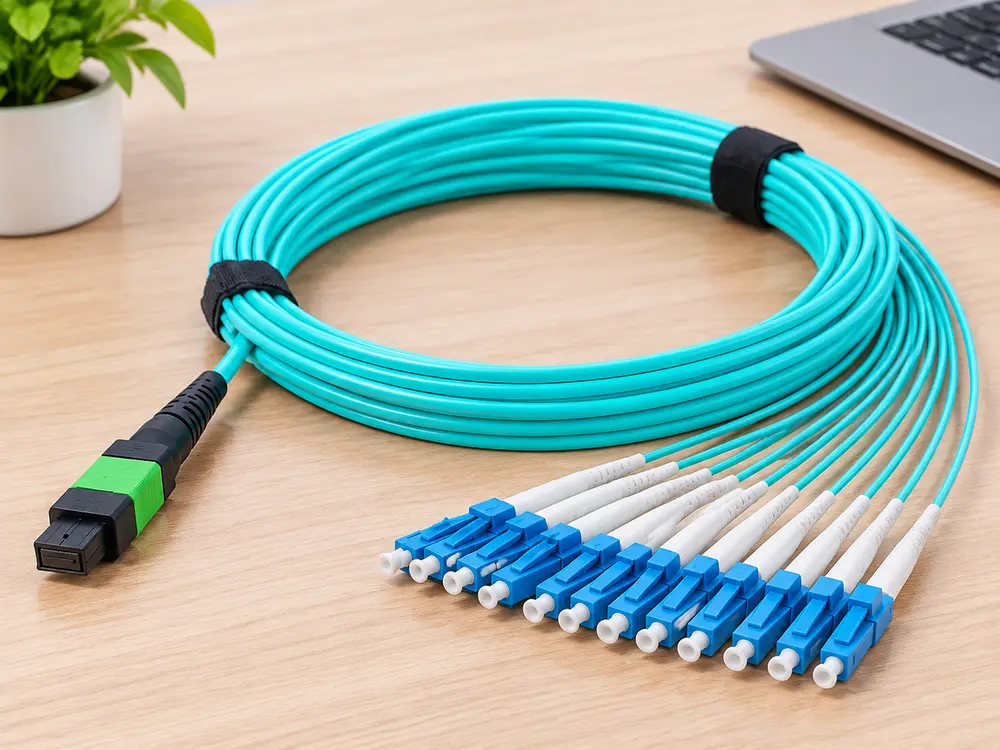
A fiber optic trunk cable is a multi-fiber assembly that connects two points within an optical network. The cable can be pre-terminated with connectors at both ends or can be made as a field-termination cable depending on the specific project.
Most pre-terminated trunk cables have multi-fiber connectors such as MPO/MTP or several individual connectors such as LC and SC. It allows installing several fiber connections in one cable assembly.
For instance, an MPO trunk cable with 12 fibers will contain 12 separate optical channels in one cable assembly. Such a configuration is especially convenient in case of data centers and other environments when hundreds and thousands of fiber connections may be necessary.
The main advantages are:
- High density of connections;
- Simplified installation process;
- Easier cable management;
- Flexibility in adding new cable assemblies as network capacity increases;
- Consistent optical performance.
Main Types of Fiber Optic Trunk Cables
There are various types of fiber optic trunk cables. Each type depends on connector requirements, fiber count, and network design.
MPO/MTP Fiber Optic Trunk Cable
MPO/MTP trunk cables use multi-fiber connectors to accommodate several fibers in one interface. Such assemblies include various fiber counts – 8 fibers, 12 fibers, 16 fibers, and 24 fibers.
MPO/MTP trunk cables are widely used in high-density data centers and parallel optical transmission systems. Depending on the arrangement of fibers and the transceiver design, MPO/MTP cabling can provide up to 40G, 100G, 200G, and 400G network connections.
LC Fiber Optic Trunk Cable
LC trunk cables use small-form-factor LC connectors and usually have multiple LC connectors located at each end of a cable assembly.
Such cable assemblies are used to connect fiber distribution panels, network switches, servers, and optical transmission equipment. Small-size connectors of such assemblies are especially helpful in high-density rack installations.
SC Fiber Optic Trunk Cable
SC trunk cables use easy-to-connect push-pull SC connectors providing a reliable connection.
Such cables are widely used in telecommunications networks, fiber distribution systems, and FTTH networks. There are different types of SC connectors depending on polishing: UPC or APC. They should be selected according to optical interface requirements.
Hybrid Fiber Optic Trunk Cable
Hybrid fiber optic trunk cables have various connector types installed at opposite ends. Examples are MPO-to-LC and MPO-to-SC configurations.
Such types of fiber optic trunk cables are used for connection of equipment with different types of interfaces. For example, the MPO-to-LC trunk cable will allow connecting MPO-based backbone network with equipment having LC ports.
Important Specifications of Fiber Optic Trunk Cables
It is crucial to learn about important specifications of a trunk cable before purchasing it.
| Specification | Common Options |
| Fiber Type | Single-mode OS2, Multimode OM3, OM4, OM5 |
| Fiber Count | 8, 12, 24, 48, 72, 144 fibers |
| Connector Type | MPO, MTP, LC, SC, FC |
| Cable Structure | Round cable, ribbon cable, breakout cable |
| Polarity | Type A, Type B, Type C |
| Jacket Material | PVC, LSZH, OFNP |
| Cable Length | Customized according to installation requirements |
Fiber type: Single-mode OS2 is usually used for long-distance optical transmission. Multimode OM3 and OM4 fibers are used for short connections, mostly in data centers.
Fiber count: Fiber count defines the number of optical channels that can be accommodated in one single cable assembly. Higher fiber count can be used for large-scale installations, but the actual requirement is defined by network design.
Connector type: MPO/MTP connectors are suitable for multi-fiber connections while LC and SC connectors are commonly used for individual optical ports.
Cable jacket: PVC jackets are used in many general-purpose cable assemblies. LSZH (Low Smoke Zero Halogen) jackets are used indoor to reduce smoke and halogen emissions during fires.
Polarity: MPO/MTP trunk cables require correct polarity configuration to ensure proper alignment of transmitting and receiving fibers. Type A, Type B, and Type C configurations are commonly used in different network architectures.
Applications of Fiber Optic Trunk Cables
Fiber optic trunk cables are important parts of modern communication infrastructure due to high fiber density and wide variety of applications.
Data Center Interconnections
Many data centers have a lot of optical connections between switches, servers, and distribution panels. The use of MPO/MTP trunk cables allows reducing cable congestion and providing high-density cabling.
They are especially useful in networks using 40G, 100G, and even higher-speed optical transmission technologies.
Telecommunication Networks
Telecommunications operators use fiber optic trunk cables to create connections between optical distribution frames, transmission equipment, and network cabinets organizing ordered connections between different sections of communication network.
FTTx Infrastructure
In FTTx networks, fiber optic trunk cables are used to organize connections between central offices, distribution points, and access network equipment bringing optical signals closer to premises.
Enterprise and Campus Networks
Large office buildings, industrial facilities, and university campuses usually have many communication rooms. Trunk cables allow organizing connections between such rooms and simplify centralized fiber management.
How to Choose the Right Fiber Optic Trunk Cable
Choosing the right trunk cable requires consideration of the whole network architecture rather than only connector type.
Six important factors:
- Calculate the transmission distance.
Use OS2 single-mode fiber for long-distance connections or suitable multimode fiber for shorter ones. - Calculate the required fiber count.
Estimate the current requirements and leave some extra capacity for future expansion. - Check the compatibility of connectors.
Review the interfaces of switches, patch panels, and optical transceivers before choosing MPO, LC, or SC connectors. - Check MPO polarity.
Ensure that MPO polarity configuration is compatible with the transmission architecture and connected equipment. - Calculate the required installation length.
Choose the cable length matching the routing path, positions of racks, and cable trays. - Consider the installation environment.
Choose the appropriate jacket material and cable structure for indoor, outdoor, or fire safety installations.
In practical projects, connector compatibility and polarity require special attention. Even in case of correct selection of fiber type and connector, improper polarity configuration may prevent the optical link from working correctly.
Fiber Optic Trunk Cable vs. Fiber Optic Patch Cord
Despite the fact that fiber optic trunk cables and patch cords provide the same functions, there are important differences in their structure and applications.
| Comparison | Fiber Optic Trunk Cable | Fiber Optic Patch Cord |
| Fiber Count | Multiple fibers | Usually 1 or 2 fibers |
| Main Function | Connects network distribution points | Connects individual devices and ports |
| Typical Application | Backbone and structured cabling | Equipment-level connections |
| Cable Structure | Multi-fiber or ribbon construction | Simplex or duplex construction |
| Installation | Large-scale fiber deployment | Flexible equipment connections |
Generally speaking, fiber optic trunk cables are used to create the main pathways between distribution points while fiber patch cords provide connection to devices. In many cases, trunk cables become the main routes for optical fibers, while patch cords provide the last connection to devices.
Why Fiber Optic Trunk Cable Quality Matters
Quality of fiber optic trunk cable directly influences the performance of optical transmission and network reliability. Inappropriate termination of connectors, damage of fibers, and inconsistencies in manufacturing may result in high signal attenuation and unstable connections.
In evaluating a fiber optic trunk cable, consider these aspects:
- Insertion Loss: Lower insertion loss reduces signal attenuation at connections.
- Return Loss: Higher return loss reduces the level of reflected optical power providing more stable transmission.
- Connector End-Face Quality: Proper polishing and clean connector surface provide reliable optical connections.
- Mechanical Strength: The cable should be able to withstand typical tensions and bends during installation.
- Manufacturing Consistency: Reliable production and testing of cable assemblies guarantee consistent optical performance.
For large-scale projects such as data centers and telecommunications installations, it is recommended to ask for factory test reports and ensure that cable assemblies meet required optical performance.
Conclusion
Fiber optic trunk cables are critical components of high-density optical networks. Combining several fibers in a single cable assembly makes installation easier and improves cable management. They become the main way of optical connectivity in data centers, telecommunication networks, and FTTx infrastructures.
Huijue Group offers a wide variety of fiber optic connectivity products including fiber optic trunk cables, patch cords, pigtails, PLC splitters, and other accessories. Proper selection of fiber type, connector configuration, and fiber count allows ensuring compatibility with existing equipment and proper network operation.
 Hot Article

Founded in 2002, Huijue Networks is a high-tech service manufacturer integrating intelligent network communication equipment and an integrated application of computer intelligent network communication systems.
Set a Consultation Today