


How Much Is Fiber Optic Cable in 2026?



Prices of fiber optic cables differ according to the cable category, fiber count, cable structure, and purchasing quantity. In 2026, a practical China factory price range will be roughly US$0.03-0.50 per meter for most standard telecom fiber optic cables, while specialty ADSS, armored, high-core count, and high-strength cables may cost US$0.50-1.30+ per meter.
For huge overseas projects, directly purchasing from China manufacturer can make a significant difference because the factory price is just a part of the ultimate price.
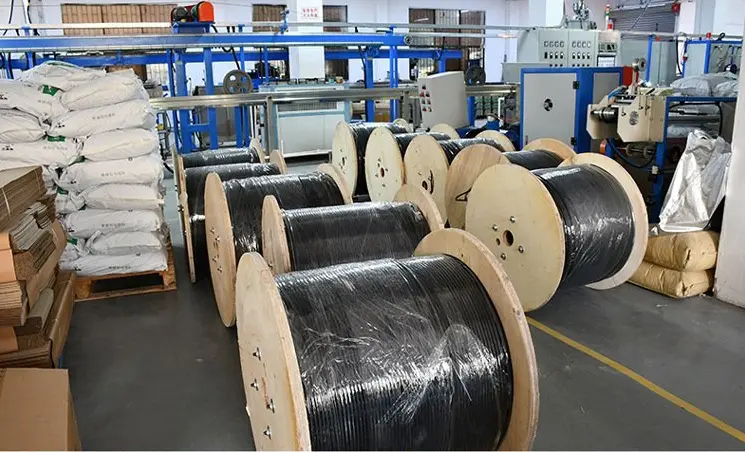
Typical Fiber Optic Cable Prices from China
The following ranges are useful starting points for 2026 procurement. They should not be treated as fixed quotations because cable specifications can change the price substantially.
| Fiber optic cable type | Typical China factory price | Approx. price per km |
|---|---|---|
| FTTH drop cable, 1–2 core | US$0.03–0.05/m | US$30–50/km |
| Basic outdoor GYXTW cable | US$0.05–0.17/m | US$50–170/km |
| 24-core GYTA/GYTS | US$0.15–0.41/m | US$150–410/km |
| 24-core ADSS | US$0.27–0.35/m | US$270–350/km |
| 48-core ADSS | US$0.45–0.47/m | US$450–470/km |
| 96-core ADSS | US$0.84–0.86/m | US$840–860/km |
| 144-core ADSS | US$1.27–1.29/m | US$1,270–1,290/km |
These figures are based on currently published Chinese supplier quotations and should be regarded as market reference ranges rather than standardized market prices. For example, a Chinese supplier currently lists 24-core ADSS at about US$282–285/km, 48-core ADSS at US$463–467/km, 96-core ADSS at US$845–853/km, and 144-core ADSS at US$1,275–1,288/km.
The large difference between different cables is normal. A simple FTTH drop cable is not comparable with a 144-core aerial ADSS cable designed for long spans and higher mechanical loads.
Why Fiber Optic Cable Prices Vary So Much
The fiber count is only one factor.
Usually, the major cost drivers will include:
- Fiber count
The materials needed for the 2-core cable and 144-core cable are quite different. - Cable construction
GYTS, GYTA, GYXTW, ADSS, armored underground cable, FTTH drop cable, and others are designed for different environments. - Type of fiber
G.652D is often used in outdoor conventional network, while G.657A1/A2 is common in FTTH due to its improved bending performance. - Mechanical requirements
ADSS cables should resist to the installation in aerial environment. The span length, tensile strength, jacket type, amount of aramid yarn, etc. will impact on the quotation. - Purchasing quantity
Larger orders usually get factory price discount. It is obvious in the current supplier quotations. - Packaging and logistics
Wooden drums, cable length, export packaging, loading requirement, etc., will impact on the final price, especially for overseas projects.
Chinese Optical Fibre Cables Export Market
China continues to be among the leading countries in producing and exporting fiber optic cables. The current statistics indicate that China is still a big and vibrant export market for fiber optics in 2026.
According to the trade statistics, during the first seven months of 2026, the country exported optical fibre cables under HS code 854470 worth US$2.61 billion, increasing by 49.88% compared with last year. The US received the biggest share at about US$978 million, followed by Hong Kong and Malaysia.
To the foreign buyers, the huge volume of exports indicates that Chinese companies can provide competitive prices for the standard FTTH, outdoor, telecom, ADSS, or high core count fiber optics cables. However, factory price is not the same as the purchasing cost.
If the purchase from China is cheaper or not depends on order quantity and total delivered cost. In case of small order, the purchase through a local distributor will be cheaper since there will be no international freight and customs clearance. For bigger projects, low factory price will be able to cover the shipping and other import costs.
Thus, a 100 kilometers fiber optic cable project differs a lot in costs from a 2 kilometers maintenance work. That is why it is necessary to compare Chinese factory price with the local supplier’s price in case of same cable specification and quantity.
In practice, the direct purchase from a Chinese manufacturer becomes more economically justified as the order volume grows especially if standard or custom fiber optic cable is needed.
How Much Should You Budget for Your Project?
Assume a telecom project needs 100 km of 24-core ADSS cables.
According to the approximate factory price of US$280-350/km, the cost of the cable will be around:
100 km × US$280-350/km = US$28,000-35,000
It is the product cost, not necessarily the final delivered cost.
For an overseas buyer, the full procurement budget will also include:
- Export packing and documentation
- Ocean or air freight
- Marine insurance
- Import duty and VAT if any
- Customs clearance
- Inland transport
- Installation accessories
- Connectors, closures, splice tray, and other network components
It is why only comparing two suppliers by the quoted price per kilometer can lead to misunderstanding.
China Factory Price vs Delivered Price
From my experience working with telecom equipment and network products, sometimes, the cheapest quotation is not the cheapest solution.
The supplier with the US$0.15/m price may seem much cheaper than the US$0.25/m supplier. The reason could be a different fiber grade, lower mechanical performance, jacket material, drum length, testing requirement, etc.
For international projects, I suggest you compare at least the following specification:
Fiber type + Core count + Cable construction + Tensile strength + Attenuation + Jacket material + Standard + Packing length + Incoterm
Only then, you will have a meaningful comparison.
Fiber Optic Cable Price Outlook for Late 2026 and 2027
Considering the 2023-2025 trading trend and current Chinese supplier quotations, I would not expect the dramatic increase of standard fiber optic cables’ price in the second half of 2026.
Due to the large manufacture capability and export capacity of China, common telecom fiber optic cables’ price will stay relatively competitive. However, the prices for high-core-count ADSS cables, specialty armored cables, and customized cables will be able to fluctuate more significantly since they are highly dependent on material specification and project requirement.
For budgeting purposes, using a rough 0–8% price fluctuation range for standard cables through 2027 is more realistic than assuming a fixed price. This is a planning assumption, not a guaranteed market forecast.
Buy Fiber Optic Cable from the Manufacturer Directly
Huijue Network supplies fiber optic cable for telecom, FTTH, FTTx, outdoor communication, and network infrastructure projects. As a source manufacturer, we can configure cable construction, fiber count, jacket, strength member, drum length, and other specifications according to the project.
The final price depends on the exact cable you need and the delivery destination. Contact Huijue Network with your required fiber count, cable type, total quantity, and destination country, and we can provide a project-specific quotation rather than a generic online price.
 Hot Article

Founded in 2002, Huijue Networks is a high-tech service manufacturer integrating intelligent network communication equipment and an integrated application of computer intelligent network communication systems.
Set a Consultation Today